
How to Grow Lettuce Hydroponically at Home: Complete Beginner's Guide

Learn how to grow hydroponic lettuce at home with this beginner's guide — setup, nutrients, pH & EC levels, harvesting tips, and costs.
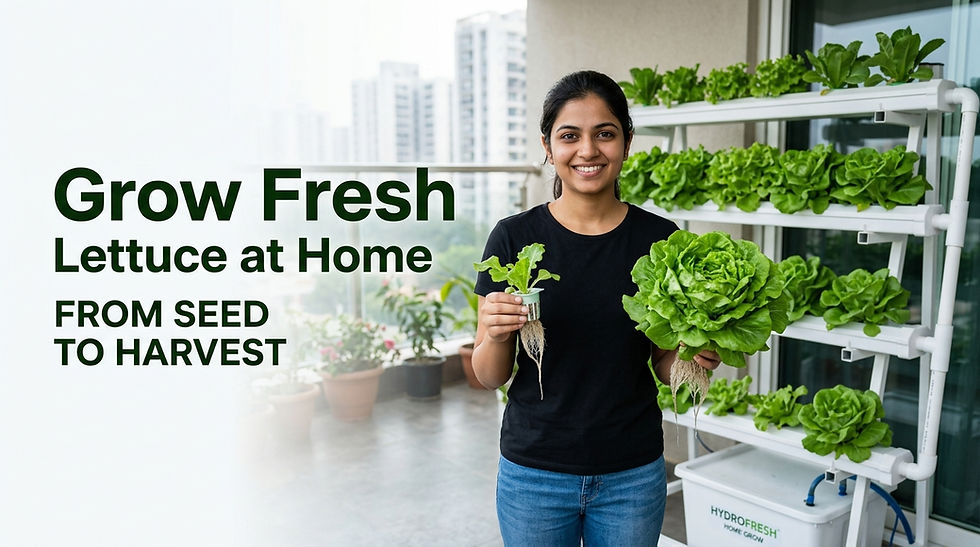
If you've ever bought a bag of lettuce that went limp in the fridge two days later, you already understand the appeal of growing your own. Lettuce happens to be one of the easiest, fastest, and most forgiving crops to grow hydroponically — which is exactly why it's usually the first thing people try when they get curious about hydroponic farming.
This guide walks you through everything you need to start growing lettuce hydroponically at home, even if you've never grown so much as a windowsill herb before. By the end, you'll know what equipment you actually need (and what you don't), how to germinate and transplant seedlings, how to manage nutrients and pH, and what it realistically costs to get going.
What Is Hydroponic Lettuce Cultivation?
Hydroponic lettuce cultivation means growing lettuce without soil — instead, the roots sit in or are exposed to a nutrient-rich water solution that delivers everything the plant needs directly. No digging, no weeding, no guessing whether your soil has the right nutrients left in it.
Because lettuce has a shallow root system and a short growth cycle, it adapts extremely well to hydroponic systems. Commercial growers rely on it as a staple crop for exactly this reason, and home growers benefit from the same advantages: faster growth, cleaner produce, and a setup that fits easily into an apartment, balcony, or spare room.
If you're new to hydroponics for beginners in general, lettuce is genuinely the best place to start. It's low-risk, quick to show results, and teaches you the fundamentals — nutrient balance, pH, light — that apply to almost every other hydroponic crop you'll eventually want to grow.
Benefits of Growing Lettuce Hydroponically
Before you invest time and money into a setup, it's worth understanding exactly why growing lettuce hydroponically beats the traditional soil-based approach for most home growers.
Faster Growth Cycles
Hydroponic lettuce typically reaches harvest size in 30–45 days, compared to 55–70 days in soil. Direct access to nutrients and oxygen at the root zone speeds everything up.
Water Efficiency
Hydroponic systems recirculate water instead of letting it drain away into soil, using significantly less water than conventional growing — a real advantage if you're growing indoors or in a water-conscious household.
Pesticide-Free, Cleaner Produce
Without soil, you remove most of the soil-borne pests and diseases that typically require chemical intervention. That means cleaner, more consistent lettuce with no pesticide residue to worry about.
Space-Saving and Year-Round Growing
You don't need a garden. A balcony, a kitchen corner, or a spare shelf is enough. And because you control the environment, you're not at the mercy of season or monsoon — you can grow lettuce hydroponically all year round.
Consistent Quality
Every head of lettuce grows in the same controlled conditions, so you get uniform size, texture, and flavor — something that's genuinely hard to achieve with soil-based gardening.
Materials and Equipment You'll Need
You don't need a commercial-grade setup to start growing lettuce hydroponically at home. Here's what a basic beginner kit looks like:
A hydroponic system — Deep Water Culture (DWC) or Nutrient Film Technique (NFT) are the easiest for beginners
Net pots to hold your seedlings and growing medium
Growing medium — rockwool cubes or coco coir are both good, beginner-friendly choices
A reservoir to hold your nutrient solution
An air pump and air stone (for DWC systems) to keep the nutrient solution oxygenated
A water pump (for NFT or recirculating systems)
Hydroponic nutrient solution, formulated for leafy greens
A pH testing kit or digital pH meter
A TDS/EC meter to measure nutrient concentration
Grow lights (LED full-spectrum lights work well if you don't have consistent natural sunlight)
Lettuce seeds — loose-leaf varieties like Lollo Rossa, Butterhead, or Romaine are beginner-friendly
Most of this is a one-time investment, and a basic setup can be built with materials that cost far less than people expect.
Step-by-Step Setup Process
Step 1: Choose Your System
For home growers, a small DWC bucket system or a compact NFT channel is ideal. Both are simple to build or buy pre-assembled, and both work well for lettuce specifically because of its shallow root structure.
Step 2: Set Up Your Reservoir
Fill your reservoir with clean, filtered water. Avoid using water straight from a heavily chlorinated municipal supply without letting it sit for 24 hours first — chlorine can interfere with root health.
Step 3: Install Your Net Pots and Growing Medium
Place your growing medium (rockwool or coco coir) into your net pots. This is what will hold your seedling in place once it's ready to transplant.
Step 4: Add Your Air Pump or Water Pump
If you're running a DWC system, submerge your air stone and connect it to the air pump to keep the water oxygenated. For NFT systems, set up your water pump to keep a thin, continuous film of nutrient solution flowing across the roots.
Step 5: Mix Your Nutrient Solution
Add your hydroponic nutrient solution to the reservoir according to the manufacturer's instructions, then check and adjust your pH and EC levels (more on the ideal ranges below).
Step 6: Set Up Lighting
Position your grow lights 12–18 inches above where your plants will sit, and set them on a timer for around 14–16 hours of light per day.
Seed Germination and Transplanting
Getting germination right sets the tone for your entire grow, so it's worth slowing down here.
Soak your rockwool cubes in pH-adjusted water before placing seeds.
Place 1–2 lettuce seeds per cube, just below the surface.
Keep the environment humid — a humidity dome or plastic wrap over your germination tray helps a lot.
Maintain a temperature of 18–22°C (65–72°F) for the best germination rates.
Expect germination within 3–7 days, depending on the variety.
Once your seedlings have developed their first true set of leaves (not just the initial seed leaves) and a small root system is visible poking through the growing medium, they're ready to transplant into your net pots and hydroponic system. Handle the root ball gently — lettuce roots are delicate at this stage, and rough handling can stunt early growth.
Nutrient Management Basics
Lettuce is a leafy green, which means it needs a nutrient mix relatively higher in nitrogen to support leaf growth, along with balanced potassium and phosphorus, plus micronutrients like calcium, magnesium, and iron.
Use a nutrient solution specifically formulated for leafy greens rather than a general-purpose or fruiting-crop formula — fruiting crops like tomatoes need very different nutrient ratios at different growth stages, and using the wrong formula is one of the most common beginner mistakes.
Refresh your nutrient solution every 1–2 weeks, and top up water in between as your plants absorb it. Always check your EC levels before topping up, since plants absorb water faster than nutrients, which can cause your solution to become overly concentrated over time.
Ideal pH and EC Levels for Lettuce
This is the part beginners most often get wrong, and it's also the part that matters most.
Ideal pH range: 5.5–6.5, with 6.0 being a reliable sweet spot for most lettuce varieties
Ideal EC range: 0.8–1.2 mS/cm for young seedlings, rising to 1.2–1.8 mS/cm as plants mature
If your pH drifts too high or too low, your lettuce won't be able to absorb nutrients properly even if your nutrient solution is perfectly mixed — this is one of the most common reasons for stunted or yellowing plants. Check pH and EC every 2–3 days using your meter, and adjust gradually rather than in large swings, since sudden changes can shock your plants.
Common Problems and Solutions
Yellowing Leaves
Usually a sign of nitrogen deficiency or incorrect pH blocking nutrient uptake. Check and correct your pH first, then review your nutrient concentration.
Root Rot
Caused by low oxygen levels or water that's too warm. Keep your reservoir temperature below 22°C (72°F) and make sure your air pump is running consistently in DWC systems.
Slow or Stunted Growth
Often linked to insufficient light or incorrect EC levels. Increase light duration or intensity, and double-check your nutrient concentration isn't too diluted.
Algae Growth
Light leaking into your reservoir or nutrient channel encourages algae. Cover exposed reservoirs and use opaque containers or channels wherever light might reach the water.
Tip Burn
Calcium deficiency, often triggered by rapid growth and high humidity. Ensure your nutrient mix includes adequate calcium and improve airflow around your plants.
Harvesting Tips
Most hydroponic lettuce varieties are ready to harvest 30–45 days after transplanting, depending on the variety and growing conditions. A few tips to get the most out of your harvest:
Harvest in the morning when leaves are crisp and hydrated.
For loose-leaf varieties, harvest outer leaves as needed and let the plant continue producing from the center — this can extend your harvest window significantly.
For head varieties, harvest the entire plant once it reaches full size, cutting just above the root base.
Rinse gently and store in a breathable container in the fridge — hydroponic lettuce, grown without soil, typically needs far less washing than store-bought produce.
Take Your Skills Further: Maximum Cultivator's Modern Hydroponic Course

Growing your first batch of lettuce is a great start — but if you're serious about hydroponic farming as a long-term hobby, side income, or full career, structured training makes the difference between guessing your way through problems and actually understanding what's happening in your system.
That's exactly what Maximum Cultivator's Modern Hydroponic Course is designed for.
This is a 90-day structured learning program that takes you from the fundamentals all the way through to running hydroponic systems with real confidence. It's built for a wide range of learners — beginners, students, job seekers, and entrepreneurs — so whether you want to grow lettuce on your balcony or launch a commercial hydroponic farm, the course adjusts to your goals.
The curriculum covers:
Nutrient management for different crop types and growth stages
pH & EC maintenance, including how to diagnose and correct imbalances
Germination techniques for reliable, healthy seedling starts
Hydroponic systems, comparing DWC, NFT, drip, and other setups
Commercial farming principles, for anyone considering hydroponics as a business
On completion, learners receive a certificate, giving real, demonstrable credibility whether you're applying for a job in the growing hydroponics sector or pitching your own venture to investors.
The course also includes a set of practical hydroponics books, including the Nutrient Management Guide, pH & EC Maintenance Guide, Germination Guide, and other hydroponic learning resources — giving you reference material you can return to long after the course itself is finished.
Comments