
Learn. Grow. Earn. Build Your Hydroponics Future with Maximum Cultivator

Discover how to build a career or business in hydroponics with Maximum Cultivator's Modern Hydroponics Course. Learn, grow, and earn in 2026.

Your Future Doesn't Have to Depend on Soil Anymore
Picture this. A small room in a city apartment. No farmland in sight. Yet inside, rows of lettuce, basil, and strawberries grow taller every single day, fed by nothing but water and precisely balanced nutrients.
This isn't science fiction. This is hydroponic farming, and it's already happening across India right now.
If you've ever wondered whether there's a smarter, cleaner, and more profitable way to grow food or build a career in agriculture, you're in the right place. This guide walks you through everything — why hydroponics is booming, what career and business opportunities look like, and how proper training through a hydroponics course can turn curiosity into a real, sustainable future.
Let's dig in — minus the soil.
Why Hydroponics Is the Future of Agriculture
Traditional farming has fed the world for centuries. But it's under pressure like never before. Water tables are dropping. Farmland is shrinking. Climate patterns are becoming harder to predict.
Hydroponic farming offers a practical answer to these problems, and here's why it's gaining so much attention.
1. It Solves the Water Crisis
Hydroponics uses up to 90% less water than conventional soil-based farming. Since water recirculates through the system instead of soaking into the ground, very little goes to waste. In a country like India, where groundwater depletion is a growing concern, this alone makes soilless farming worth paying attention to.
2. It Works Anywhere
You don't need acres of fertile land to grow food anymore. With vertical farming, growers can stack crops in layers, making it possible to farm inside warehouses, rooftops, and even spare rooms. This is a game-changer for urban gardeners and city-based entrepreneurs who don't have access to farmland.
3. It Delivers Faster, Cleaner Yields
Because nutrients go straight to the plant roots through controlled environment agriculture, crops tend to grow faster and more consistently. There's also less exposure to soil-borne pests, which means fewer chemical pesticides are needed.
4. It's Naturally Sustainable
Hydroponics supports sustainable farming by reducing water waste, minimizing land use, and cutting down on chemical dependency. For a generation that increasingly cares about where its food comes from, this matters more every year.
Put simply, hydroponic farming isn't just a trend. It's shaping up to be a long-term answer to some of agriculture's biggest problems.
Career and Business Opportunities in Hydroponics
Here's where things get exciting. Hydroponics isn't just a farming method — it's becoming a genuine career path and business opportunity.
Hydroponic Farm Manager – Overseeing daily operations of commercial hydroponic setups
Nutrient and Crop Consultant – Helping farms optimize nutrient management and crop health
Vertical Farming Technician – Managing indoor, stacked growing systems
Agri-Tech Entrepreneur – Building and scaling your own hydroponic business
Urban Farming Educator – Teaching hydroponics to schools, communities, or corporate wellness programs
Research and Development Roles – Working with agri-tech startups innovating in controlled environment agriculture
Business Potential in Hydroponic Farming
Starting a hydroponic farming business is more accessible than most people assume. You don't need a large loan or vast land holdings to get started. Many entrepreneurs begin small, with a single grow room or greenhouse setup, and scale as demand grows.
Some popular business models include:
Direct-to-consumer produce sales – Selling fresh, pesticide-free vegetables to local households
Restaurant and hotel supply – Providing consistent, high-quality greens to the hospitality industry
Retail partnerships – Supplying supermarkets and organic stores
Hydroponic kits and consulting – Helping others set up their own systems
Educational workshops – Teaching hydroponics for beginners in your city
The demand for clean, pesticide-free produce is rising steadily in urban India, especially in metro cities where health-conscious buyers are willing to pay a premium. This creates real openings for anyone willing to learn the craft properly.
Why Learning Hydroponics the Right Way Actually Matters
Now here's something most beginners don't realize until they've already made a few costly mistakes: hydroponics looks simple on the surface, but it's built on precise science underneath.
Get the nutrient mix wrong, and your plants stall. Miss your pH and EC management targets, and roots can burn or starve. Skip proper germination steps, and half your seedlings may never make it past week one.
This is exactly why hydroponics training matters so much before you invest time and money into a full setup.
What Proper Training Gives You
Confidence to set up and manage a system correctly from day one
A clear understanding of plant nutrition and water chemistry
The ability to diagnose and fix problems quickly
A foundation for scaling from hobby to commercial hydroponic farming business
Recognized hydroponics certification that adds credibility to your work
Learning from trial and error alone can take years, and it often comes at the cost of failed crops and wasted resources. A structured hydroponics course shortens that learning curve dramatically.
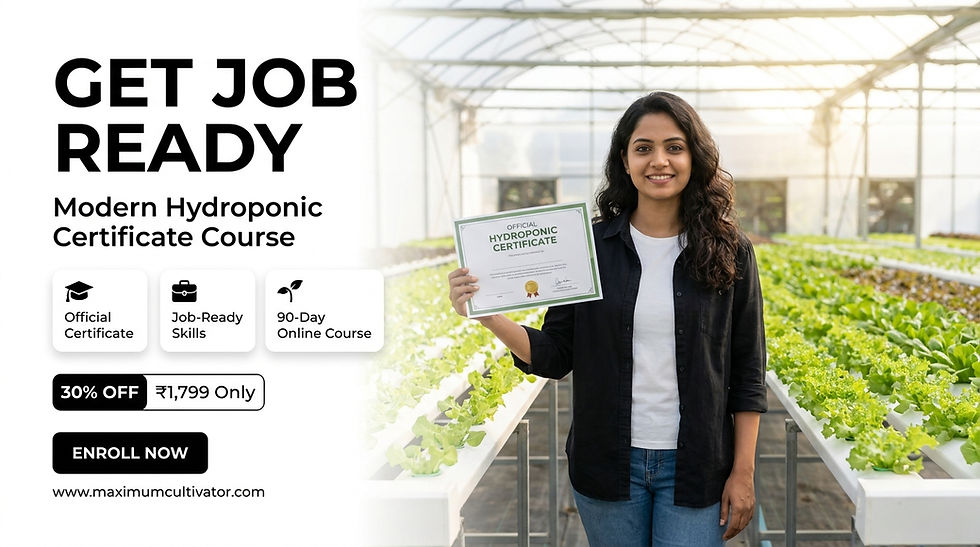
Introducing Maximum Cultivator's Modern Hydroponics Course
This is exactly the gap Maximum Cultivator set out to fill.
The Modern Hydroponics Course is a 90-day, online, beginner-friendly program built for anyone serious about learning hydroponic farming properly — whether you're a student exploring a new field, a home grower wanting fresher produce, a farmer looking to modernize, or an entrepreneur planning a full-scale hydroponic business.
Instead of throwing theory at you and hoping it sticks, the course is structured around practical, step-by-step learning. You move through each concept the way a real grower would — starting from the basics and building toward commercial-level understanding.
What You'll Learn
Hydroponic Systems – Understanding different setups and choosing the right one for your goals
Germination Techniques – How to get healthy, reliable seedling starts
Nutrient Management – Building and adjusting nutrient solutions for different crop stages
pH and EC Management – Keeping your growing environment balanced and stable
Crop Management – Caring for plants through each growth phase
Farm Planning – Structuring your setup for either home use or commercial scale
Troubleshooting – Identifying and solving common growing issues before they become bigger problems
What Makes This Course Different
90-day structured program – enough time to actually absorb and apply what you learn
Certificate of completion – recognized proof of your hydroponics training
Beginner-friendly approach – no prior farming background required
Hands-on, practical focus – less theory, more real application
Alongside the course, learners also get access to Maximum Cultivator's collection of hydroponics books, including the Nutrient Management Book, pH & EC Maintenance Book, Germination Book, and other detailed crop management guides. These resources act as ongoing reference material, so you're never left guessing once the course ends.
Whether you're aiming to grow food for your own kitchen or planning to launch a serious hydroponic farming business, this course gives you a solid, practical foundation to build on.
Practical Tips for Building a Successful Hydroponics Career or Business
Learning the fundamentals is step one. Applying them consistently is what actually builds a career or business. Here are some practical tips to keep in mind.
1. Start Small, Then Scale
Don't try to build a massive commercial setup on day one. Start with a small system, master the basics of nutrient management and pH and EC management, and expand once you're confident.
2. Choose the Right Crops
Leafy greens, herbs, and certain fruiting plants like strawberries and cherry tomatoes tend to perform well in hydroponic systems and have strong market demand in urban areas.
3. Keep Records
Track your nutrient levels, pH readings, growth rates, and harvest yields. Over time, this data helps you fine-tune your system and spot problems early.
4. Understand Your Local Market
Before scaling into a hydroponic farming business, research who your buyers will be — restaurants, retailers, or direct consumers — and what they're actually willing to pay for pesticide-free produce.
5. Keep Learning
Hydroponics is an evolving field. New techniques, systems, and research come out regularly. Staying updated through books, courses, and communities keeps you ahead.
Quick Comparison: Learning Hydroponics on Your Own vs. Structured Training
Factor | Self-Learning | Structured Hydroponics Course |
Time to competency | Months to years | 90 days |
Risk of costly mistakes | High | Significantly reduced |
Nutrient & pH/EC understanding | Trial and error | Clearly taught and practiced |
Certification | None | Certificate of completion |
Ongoing reference material | Scattered online sources | Dedicated hydroponics books |
Confidence for commercial scaling | Low to moderate | High |
Ready to Build Your Hydroponics Future?
The world of hydroponic farming is growing fast, and the best time to learn is now. Whether you're dreaming of a hydroponic career, planning a hydroponic business, or simply want fresher food at home, Maximum Cultivator's Modern Hydroponics Course gives you the practical skills, certification, and resources to get there.
Start your 90-day journey with Maximum Cultivator today — and turn your curiosity into a hydroponics future worth growing.
Learn it. Grow it. Earn from it. Your hydroponics future starts today.
Comments