
Hydroponics vs Soil Farming in India: Which is Better in 2026? (Complete Guide)

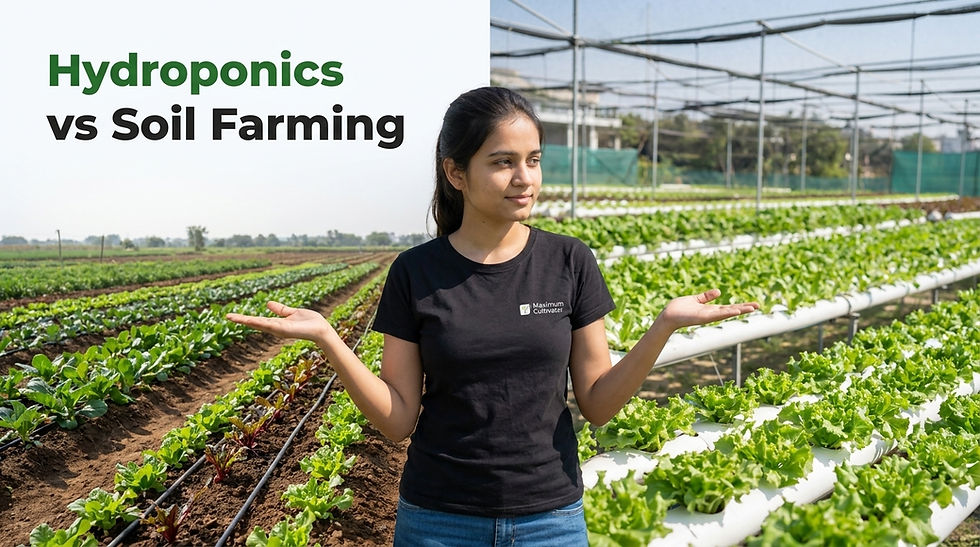
Farming in India is changing fast, and more growers are asking the same question: is hydroponics better than soil farming in India? With water shortages, shrinking farmland, and unpredictable weather becoming common challenges, many students, entrepreneurs, and commercial farmers are exploring modern alternatives to traditional agriculture.
Hydroponics, a method of growing plants without soil using nutrient-rich water, has become one of the fastest-growing segments of controlled environment agriculture in India. But does it actually outperform conventional soil-based farming? In this guide, we will break down the real differences between hydroponics and traditional farming, compare yields, costs, and profitability, and help you decide which method suits your goals.
Whether you're a beginner exploring modern farming techniques, a student researching sustainable farming, or an entrepreneur planning a commercial venture, this article gives you a clear, honest comparison.
What Is Hydroponics Farming?
Hydroponics is a soil-less farming technique where plants grow directly in a water-based nutrient solution. Instead of relying on soil for nutrients, roots receive precisely measured minerals dissolved in water, often within a controlled environment such as a greenhouse or indoor vertical farming setup.
This method allows growers to control every variable — light, temperature, humidity, pH, and nutrient concentration — resulting in faster growth and higher yields in many crops.
What Is Traditional Soil Farming?
Soil farming, the method used for thousands of years, depends on natural or amended soil to supply nutrients, water retention, and physical support for plant roots. It relies heavily on weather conditions, soil fertility, irrigation availability, and seasonal cycles.
While traditional farming remains the backbone of Indian agriculture, it faces growing challenges like soil degradation, water scarcity, and unpredictable monsoons.
Hydroponics vs Traditional Farming: Key Differences
Understanding the difference between traditional farming and modern farming is essential before choosing a method. Here's a clear, side-by-side comparison.
Comparison Table: Soil vs Hydroponics Farming
Factor | Hydroponics Farming | Soil Farming |
Water Usage | Uses up to 90% less water (recirculated system) | High water consumption, often wasted through runoff |
Space Required | Works well with vertical farming, saves land | Requires large land area |
Growth Speed | 30–50% faster growth cycles | Slower, dependent on soil and season |
Yield | Higher yield per square foot | Lower yield due to spacing and soil limitations |
Pest & Disease Risk | Significantly lower, controlled environment | Higher risk from soil-borne pests and diseases |
Weather Dependency | Minimal, works indoors or in greenhouses | Fully dependent on weather and season |
Nutrient Control | Precise nutrient and pH/EC management | Nutrient levels vary, harder to control |
Initial Investment | Moderate to high setup cost | Lower initial cost but higher long-term inputs |
Labor Requirement | Lower once system is automated | Labor-intensive throughout the season |
Soil Degradation | None, no soil used | Continuous farming can degrade soil quality |
Scalability | Easily scalable indoors or in urban areas | Limited by available farmland |
As this table shows, hydroponics vs soil farming yield comparison clearly favors hydroponics in terms of space efficiency, water conservation, and consistent output. However, soil farming still holds advantages in terms of lower entry cost and traditional crop compatibility for staple grains like wheat and rice.
Hydroponic Farming Benefits Explained
So, what exactly makes hydroponics stand out? Let's look at the advantages of hydroponics over traditional farming in more detail.
1. Massive Water Savings
India faces serious groundwater depletion in several agricultural states. Hydroponic systems recirculate water, drastically cutting consumption compared to open-field irrigation.
2. Higher Yields in Less Space
Since hydroponic systems can be stacked vertically, a small indoor unit can produce what an acre of soil farmland might yield. This makes vertical farming ideal for urban and peri-urban entrepreneurs with limited land.
3. Faster Crop Cycles
Because nutrients are delivered directly to the roots, plants don't spend energy searching for food in soil. This often results in quicker harvests, especially for leafy greens, herbs, and strawberries.
4. Year-Round Production
Controlled environment agriculture means you're not at the mercy of monsoons, droughts, or seasonal limitations. You can grow consistently, 12 months a year.
5. Reduced Pesticide Use
With no soil, many common soil-borne pests and fungal diseases are naturally eliminated, reducing the need for chemical pesticides.
6. Consistent Quality
Because every input is measured and monitored, crop quality and size remain far more consistent than soil-grown produce.
Where Traditional Farming Still Has an Edge
To keep this comparison balanced, it's important to acknowledge where soil farming still performs well:
Lower initial setup cost for small farmers
Better suited for staple crops like paddy, wheat, and sugarcane
No dependency on electricity or technical systems
Long-established government subsidies and support systems
For large-scale grain production, soil farming remains more practical today. However, for vegetables, leafy greens, herbs, and high-value crops, hydroponics is increasingly outperforming conventional methods.
Hydroponics Farming in India: Current Trends
Hydroponics farming in India is growing rapidly, especially in urban centers like Bengaluru, Pune, Hyderabad, and Delhi NCR, where land is expensive and demand for pesticide-free vegetables is rising. Restaurants, hotels, and health-conscious consumers are increasingly seeking hydroponically grown lettuce, basil, cherry tomatoes, and capsicum.
Government interest in controlled environment agriculture is also increasing, with several states offering support for greenhouse and protected cultivation projects.
Why Learning Hydroponics Properly Matters
Here's the thing — hydroponics isn't as simple as replacing soil with water. Success depends on managing nutrients, pH, and EC (electrical conductivity) precisely. Many beginners struggle because they jump into hydroponics without proper training, leading to nutrient imbalances, poor germination, or crop failure.
This is where structured learning becomes valuable. If you're serious about starting hydroponics — whether as a hobby, a home growing setup, or a commercial venture — understanding the science behind it makes all the difference.

That's exactly why Maximum Cultivator's 90-Day Modern Hydroponic Course has become a popular starting point for people across India. Designed for absolute beginners as well as aspiring commercial growers, the course offers step-by-step practical learning covering:
Germination techniques
Nutrient management
pH and EC management
Crop management across different hydroponic systems
Troubleshooting common growing issues
Commercial farming setup and scaling strategies
Students also receive a certificate after completion, along with premium learning resources such as the Nutrient Management Book, pH & EC Maintenance Book, Germination Book, and detailed Crop Management Guides — making it easier to apply what you learn in real growing conditions.
Whether you're a student exploring hydroponics for beginners, a home grower wanting fresher produce, or an entrepreneur planning a commercial hydroponic farm, this course is structured to build both theoretical understanding and hands-on confidence. If you've been considering a hydroponics course or hydroponics certificate course to properly understand this modern farming technique, this is a practical place to begin your journey.
Profitability of Hydroponics Farming in India
One of the biggest questions entrepreneurs ask is: can hydroponics actually be profitable in India? The answer depends on crop selection, market access, and system efficiency, but overall, the profitability outlook is promising.
Key Profitability Factors
Higher Yield Per Square Foot: More produce from smaller spaces means better return on investment.
Premium Pricing: Pesticide-free, hydroponically grown vegetables often sell at 20–40% higher prices in urban markets.
Reduced Water and Labor Costs: Long-term operational costs are lower once systems are optimized.
Faster Harvest Cycles: More harvests per year improve overall revenue potential.
Growing Demand: Increasing health consciousness and demand for clean produce, especially in metro cities.
Typical Profitable Crops in Hydroponics (India)
Lettuce and leafy greens
Basil and other herbs
Cherry tomatoes
Capsicum and bell peppers
Strawberries
While initial setup costs for hydroponics can be higher than traditional farming, many growers recover their investment within 12–18 months when systems are managed correctly and crops are chosen strategically based on local demand.
Conclusion: Is Hydroponics Better Than Soil Farming in India?
So, is hydroponics better than soil farming in India? For water efficiency, space utilization, crop consistency, and long-term sustainability, hydroponics clearly offers significant advantages, especially for vegetables and high-value crops in urban and semi-urban settings. Traditional soil farming still holds value for staple crops and low-investment setups, but as resources become scarcer, hydroponics is positioning itself as the future of Indian agriculture.
If you're ready to explore this future hands-on, Maximum Cultivator's 90-Day Modern Hydroponic Course offers a beginner-friendly, practical pathway to mastering hydroponics — complete with certification and premium guidebooks to support your learning journey, whether you're growing at home or planning a commercial farm.
Comments