
Best hydroponic crops for beginners in India

Discover the best hydroponic crops for beginners in India — growing times, ideal pH, profit potential, and a simple action plan to start soilless farming.
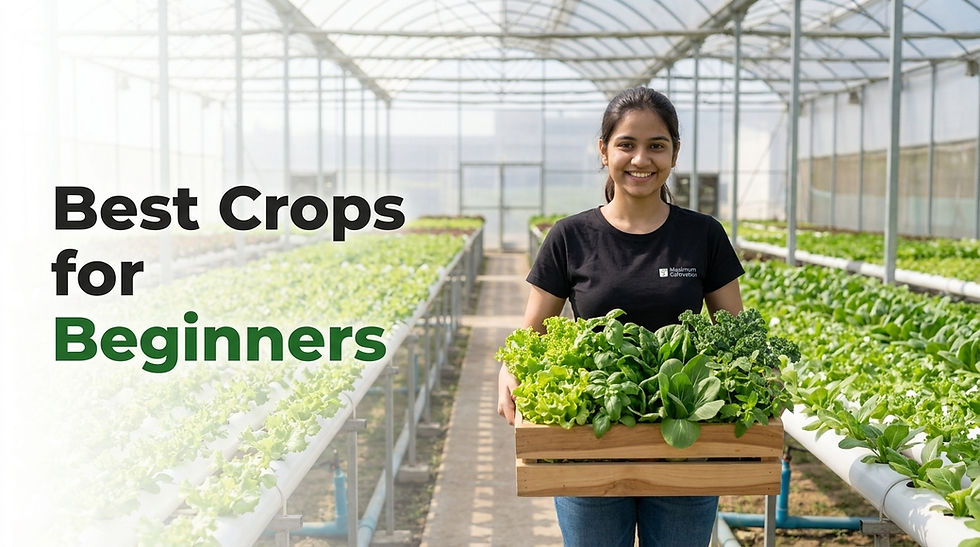
Walk into any conversation about modern farming in India right now, and hydroponics comes up faster than it used to. And for good reason. Between shrinking farmland, unreliable water supply, and a growing appetite for pesticide-free vegetables, more Indians — students, home gardeners, and first-time entrepreneurs alike — are asking the same question: which crop should I actually start with?
This guide answers that question properly. We'll walk through what hydroponics is, why it's taking off across India, what makes certain crops genuinely beginner-friendly, and then break down the ten best hydroponic crops for beginners — with growing times, ideal pH ranges, difficulty levels, and the mistakes that trip up almost everyone in their first few months.
What Is Hydroponics, and Why Is It Growing So Fast in India?
Hydroponics is the practice of growing plants without soil, using a nutrient-rich water solution to deliver everything roots need directly. No tilling, no weeding, no dependence on whatever's left in depleted soil — just precise, controlled growing.
In India specifically, this approach solves problems that soil-based farming increasingly can't. Water scarcity across large parts of the country makes hydroponics' dramatically lower water use a genuine advantage rather than a nice-to-have. Urban expansion keeps shrinking available farmland, and hydroponic systems — which can run on a balcony, rooftop, or warehouse floor — sidestep that constraint entirely. And a growing, health-conscious urban population increasingly wants vegetables grown without heavy pesticide use, which hydroponic systems naturally support thanks to their controlled, largely soil-borne-disease-free environment.
The core benefits that make hydroponic farming in India worth taking seriously:
Water savings — recirculating systems use significantly less water than open-field farming
Faster growth — direct nutrient and oxygen access at the root zone speeds up most crops noticeably
Higher yields — controlled conditions and denser planting layouts often out-produce equivalent soil space
Year-round cultivation — no dependency on monsoon timing or seasonal soil conditions
If you're new to soilless farming, this is genuinely one of the more approachable ways to get into modern agriculture — but success depends heavily on picking the right crop to start with.
What Makes a Crop Beginner-Friendly?
Not every hydroponic crop is a smart first project. Some demand precise environmental control, complex pollination management, or long growth cycles that punish small mistakes severely. The crops worth starting with tend to share four traits.
Fast Growth Cycle
Shorter cycles mean faster feedback. If something's wrong with your nutrient mix or pH, a 30-day crop tells you quickly enough to fix it before you've wasted months.
Easy Nutrient Management
Beginner-friendly crops tolerate a reasonably wide nutrient range without collapsing the moment things drift slightly off target — forgiving enough to learn on, without punishing every small miscalculation.
Lower Risk of Disease
Crops less prone to root rot, fungal issues, or pest pressure in humid Indian conditions give new growers room to make mistakes without losing an entire harvest.
Consistent Market Demand
Top 10 Best Hydroponic Crops for Beginners in India
1. Lettuce
Lettuce is the crop almost everyone starts with, and for good reason — it's forgiving, fast, and reliably in demand.
Growing time: 30–45 days
Ideal pH range: 5.5–6.5
Difficulty level: Easy
Market demand: High, especially in urban grocery and hospitality
Common mistakes to avoid: Overcrowding net pots (restricts airflow and light to lower leaves), and letting reservoir temperatures climb too high, which invites root rot.
2. Spinach
A staple leafy green with strong year-round demand across Indian kitchens.
Growing time: 35–45 days
Ideal pH range: 6.0–7.0
Difficulty level: Easy
Market demand: High
Common mistakes to avoid: Ignoring calcium levels, which leads to weak, curling leaves, and harvesting too early before proper leaf development.
3. Coriander
A kitchen essential in Indian households, coriander is fast-growing but slightly more temperamental than lettuce or spinach.
Growing time: 25–35 days
Ideal pH range: 6.0–6.7
Difficulty level: Moderate
Market demand: Very high, consistent year-round demand
Common mistakes to avoid: Sowing seeds too densely (leads to weak, leggy stems), and inconsistent light exposure, which slows growth significantly.
4. Mint
Mint grows aggressively once established, making it one of the more forgiving herbs for new growers.
Growing time: 25–30 days for early harvests
Ideal pH range: 5.5–6.5
Difficulty level: Easy
Market demand: High, particularly for hospitality and beverage markets
Common mistakes to avoid: Letting roots become rootbound without dividing, and over-fertilizing, which can actually reduce aromatic oil concentration and flavor.
5. Basil
A high-value herb with strong demand from restaurants, cafés, and home cooks experimenting with Italian and Thai cuisine.
Growing time: 30–40 days
Ideal pH range: 5.5–6.5
Difficulty level: Moderate
Market demand: High, especially in urban and premium markets
Common mistakes to avoid: Allowing water temperatures to drop too low (basil is sensitive to cold stress), and delaying pruning, which reduces bushiness and yield.
6. Pak Choi
An increasingly popular Asian green that grows exceptionally well in hydroponic systems.
Growing time: 30–40 days
Ideal pH range: 6.0–7.0
Difficulty level: Easy
Market demand: Moderate to high, growing steadily with Asian cuisine popularity
Common mistakes to avoid: Overwatering leading to soft, mushy stems, and inconsistent EC levels, which cause uneven growth between plants.
7. Kale
A nutrient-dense superfood green that's gained serious popularity among health-conscious urban buyers.
Growing time: 40–55 days
Ideal pH range: 5.5–6.5
Difficulty level: Moderate
Market demand: Growing steadily, particularly in metro cities
Common mistakes to avoid: Harvesting too aggressively too early (stunts long-term yield), and insufficient light intensity, which produces pale, thin leaves.
8. Fenugreek (Methi)
A fast-growing, traditional Indian green with dependable demand across the country.
Growing time: 20–30 days
Ideal pH range: 6.0–6.5
Difficulty level: Easy
Market demand: High, especially in North Indian markets
Common mistakes to avoid: Sowing too thickly (leads to competition and weak stems), and neglecting nitrogen levels, which are critical for methi's characteristic leaf density.
9. Microgreens
Not a single crop but a category — microgreens (radish, mustard, sunflower, and more) have exploded in popularity due to their short cycle and premium pricing.
Growing time: 7–14 days
Ideal pH range: 5.5–6.5
Difficulty level: Easy to Moderate
Market demand: Very high, particularly with premium restaurants and health-focused consumers
Common mistakes to avoid: Overwatering (a leading cause of mold in microgreen trays), and harvesting too late, which reduces tenderness and flavor.
10. Cherry Tomatoes
A step up in difficulty from the leafy greens above, but a genuinely profitable crop once you're ready to progress beyond the basics.
Growing time: 60–75 days to first harvest
Ideal pH range: 5.8–6.3
Difficulty level: Moderate to Hard
Market demand: High, strong year-round demand across retail and food service
Common mistakes to avoid: Neglecting pollination (hydroponic tomatoes often need manual or fan-assisted pollination indoors), and inconsistent EC levels during fruiting, which affects both yield and flavor.
Comparison Table: Best Hydroponic Crops for Beginners in India
Crop | Growth Time | Profit Potential | Difficulty Level | Recommended for Beginners |
Lettuce | 30–45 days | Moderate | Easy | Yes |
Spinach | 35–45 days | Moderate | Easy | Yes |
Coriander | 25–35 days | High | Moderate | Yes |
Mint | 25–30 days | Moderate–High | Easy | Yes |
Basil | 30–40 days | High | Moderate | Yes |
Pak Choi | 30–40 days | Moderate | Easy | Yes |
Kale | 40–55 days | Moderate–High | Moderate | Yes |
Fenugreek (Methi) | 20–30 days | Moderate | Easy | Yes |
Microgreens | 7–14 days | Very High | Easy–Moderate | Yes |
Cherry Tomatoes | 60–75 days | High | Moderate–Hard | No (better as a second project) |
Learning Hydroponics the Right Way
Here's the honest truth: almost every hydroponic beginner in India makes the same handful of mistakes early on — and most of them are entirely avoidable with the right foundation.
The most common ones include:
Getting pH and EC wrong — small drifts in either can block nutrient uptake completely, even when your nutrient solution is mixed perfectly
Using the wrong nutrient formula — leafy greens and fruiting crops like tomatoes need very different nutrient ratios, and mixing them up stunts growth fast
Poor germination technique — inconsistent humidity or temperature during germination leads to weak, uneven seedlings before you've even started
Choosing the wrong crop to start with — jumping straight into a demanding crop like tomatoes or capsicum before mastering leafy greens is one of the most common (and costly) beginner errors
This is exactly why structured training matters more in hydroponics than in traditional gardening — the margin for error is smaller, and self-taught trial and error can get expensive fast.

Maximum Cultivator's Modern Hydroponic Course was built specifically to close this gap. It's a 90-day online hydroponics course designed to take learners from complete beginners to confident, independent growers — covering everything from nutrient management and pH & EC control to germination technique and full system setup.
The course includes:
A certificate upon completion, giving you real credibility whether you're job-hunting in the hydroponics sector or pitching your own venture
Practical hydroponic training that goes beyond theory into actual hands-on system management
A Nutrient Management Book, breaking down exactly what different crops need at each growth stage
A pH & EC Maintenance Book, covering the two variables most beginners get wrong
A Germination Guide, walking through reliable seed-starting techniques
Additional hydroponic learning resources and books covering crop management and growing systems
Whether you're a student exploring career options, a home gardener wanting to get serious, or an aspiring entrepreneur planning a commercial setup, this structured path helps you skip the expensive trial-and-error phase that trips up most self-taught growers — and go straight to building a system that actually works.
Conclusion
Hydroponics rewards patience and consistency far more than it rewards big, ambitious first attempts. Start small, pick a forgiving crop, learn how your system actually behaves, and only then scale up. The beginners who succeed aren't the ones who buy the most expensive equipment — they're the ones who learn the fundamentals properly before they need them.
If you're ready to move beyond guesswork and build real, lasting skills in hydroponics for beginners, join Maximum Cultivator's Modern Hydroponic Course today and explore our complete range of hydroponics books — your fastest, most reliable path from your first seedling to a thriving hydroponic system.
.
Comments